


A few weeks ago, I brought some papers into the office and tacked them to my cubicle wall, not to decorate, but to stare. What Adam Savage calls “mooning.” I felt a novel pride. When someone asked, I explained that I’d been teaching myself printmaking, the process of enlarging photos from negatives and developing photographic/enlarging paper to create prints. “You have so many hobbies!” they said, probably because I bring in 3-printed trinkets occasionally. The printmaking is new, but I like the focus it requires. All of my hobbies are in search of turning off my brain.
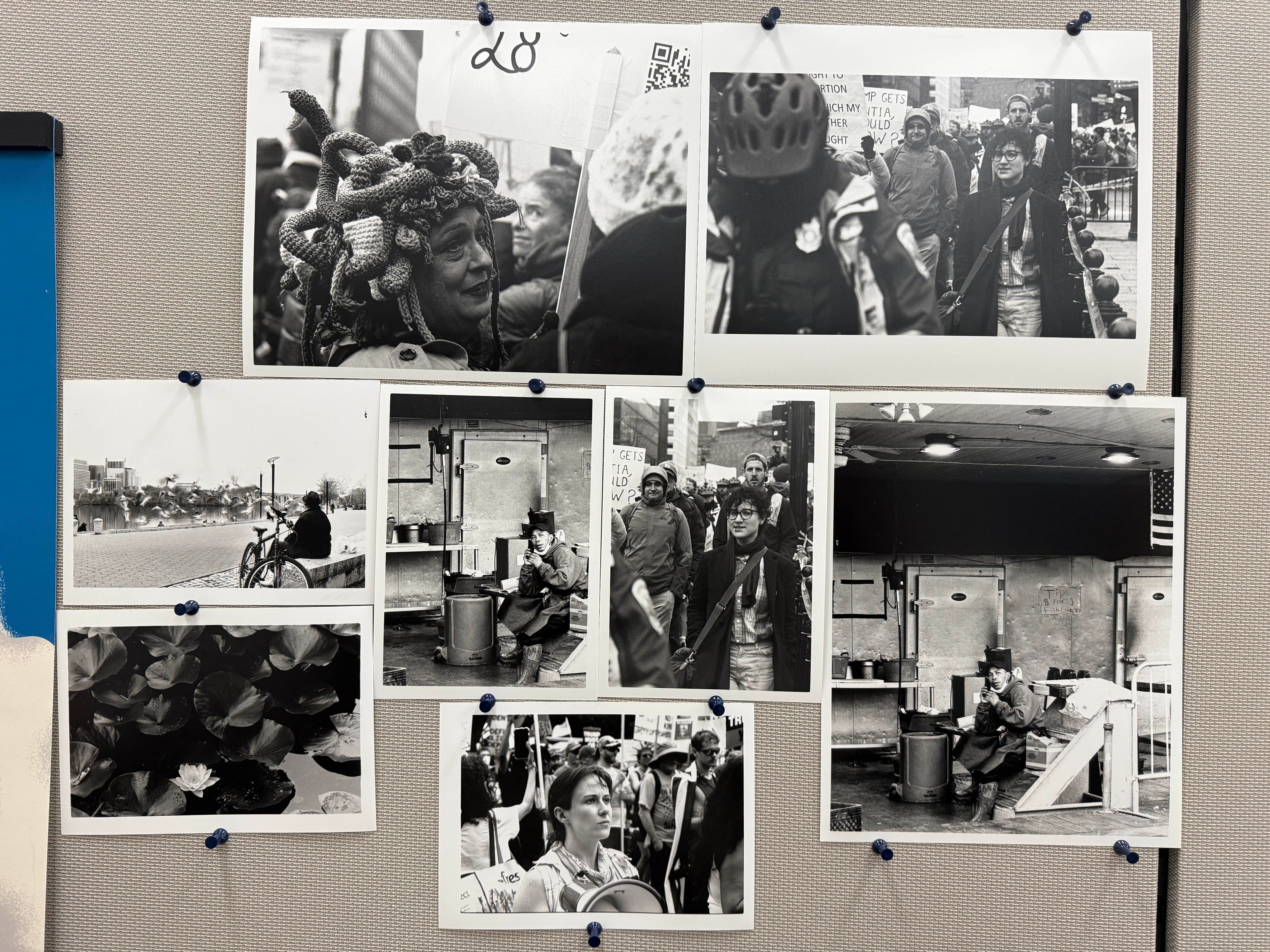
Back in June, I photographed WorldPride, and a few shots came out well. Some of them felt like they conversed with each other, so I used Photoshop to make a triptych, three images together separated by a few centimeters. I stared at it enough that I decided I should hang it on my wall. I’ve never felt that way about something I’ve made before. I uploaded it to The Darkroom and paid about $20 to have it printed on Ilford photographic paper. That ate at me over the next week or two, as they processed and eventually shipped it. I felt I could and should learn to process my film myself, from start to finish. Like many of my new hobbies, printmaking started with a middle-of-the-night eBay purchase. I spent a week or so after scrolling, making offers on used items and slowly assembling the rest of the needed equipment.


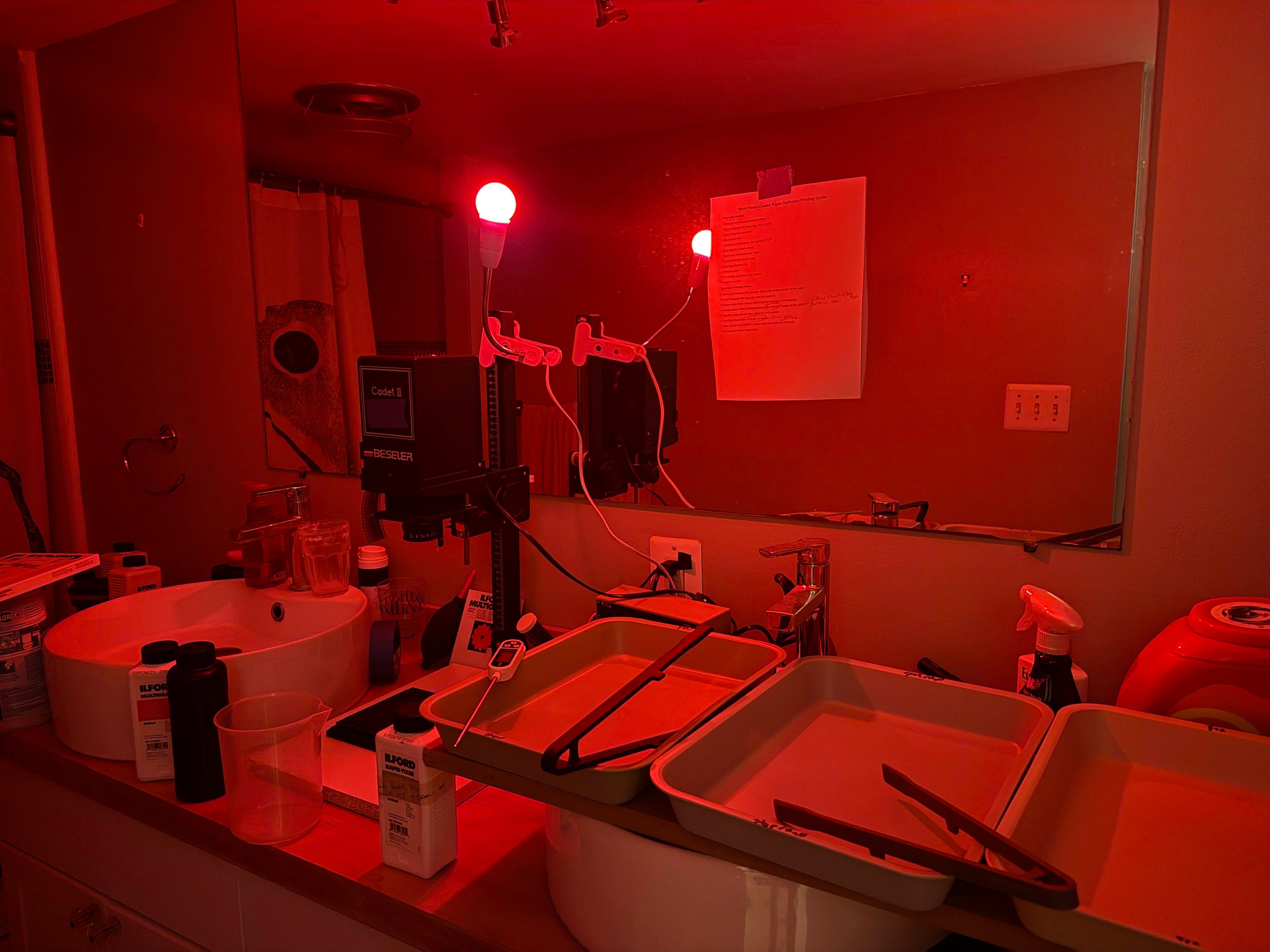
That equipment? An enlarger (I bought a used Beseler Cadet II for $50, sans lens), a lens (I put in an offer on a 50mm EL-Nikkor for about $40), contrast filters, a focus finder (another offered price), melamine board to mount the enlarger on (a trip to home depot), trays, tongs, a darkroom timer (another offer), a safelight, enlarging paper, and developer. I also needed a few things that’d be either harder to find/buy or easy enough to make myself not to justify the expense. I turned to my 3D-printer and CAD software to design, prototype, and fabricate a locking ring adapter for the lens. I also designed and printed enlarging easels, teaching myself how to embed magnets to make them quicker and easier to use.


Much of what I bought arrived covered in dust, but otherwise in good condition. Returning from home one evening, I unboxed the enlarger on my cleared-off workbench and took a look. I had no manual, but found an exploded diagram online, and set about disassembling it totally, cleaning every inch. I marked and drilled holes to mount it on one of the melamine boards (the offcuts likely doomed to sit under my workbench for years). Once I made the lens adapter, everything clean and assembled, I tested the electronics, figured out how to work the timer and the safelight.
Once I had everything together, the idea of starting intimidated me. I printed some instructions and taped them to the bathroom mirror, thinking about how I would move in the room, how I would set things up. I procrastinated further by designing a gridfinity bathroom tray to hold the toiletries on my counter, ostensibly so I could quickly convert the space to a darkroom.
The need for darkness is what helped me start. That, and my long-term insomnia. Enlarging paper is quite sensitive to light, and is ruined with accidental exposure, necessitating absolute darkness. There’s a window in my shower that I can’t block light-tight, so I must wait until nightfall. That suits me just fine, because I’ve had a harder time sleeping over the past year than I used to. I go to bed and my thoughts spiral away from me. It’s been a hard year, and sometimes I wonder if the good part of life will ever start. I feel a cold space, I miss friends I don’t see anymore. I stress myself in memories and cruel scenarios that never happened. I often wake up several times a night. There’s no other way to put it: my sleep is seriously disordered. Grief, loss, worldly stress. Not a little self-hatred and self-anger.
What did Hemingway write about nighttime and sleep in The Sun Also Rises? Take your pick. Maybe, “It is awfully easy to be hard-boiled about everything in the daytime, but at night it is another thing.” What about, “My head started to work. The old grievance.” Or maybe even, “But I could not sleep. There is no reason why because it is dark you should look at things differently from when it is light. The hell there isn’t!” Hemingway, you ass, I wish you hadn’t written something that speaks so well to me. My love-hate relationship with his work continues.
Anyway, I’m grateful, then, to have something I can do one night, mind spinning. I put in one EarPod, “Siri, play my sing-along playlist.” Usually that music is reserved for solitary wine drinking. I remove the toiletries with that printed tray, and set an MDF board across one of the sinks (my bathroom has what I insist be called a his & his vanity, though in my case it’s more like, ‘his and used once every few months’). On the board I place three trays with their tongs in them. Yet without a home in my increasingly cramped apartment, the enlarger sits on my workbench next to the 3D printer, piled with the timer, easels, focus finder, contrast filters, and the safelight is clamped to the top. I lug all that into the bathroom and set it between the sinks. I pull the enlarging paper from a drawer next to my desk, along with my negative storage box. From that, I take archival sheets where I’ve flagged the frames I want to print. Finally, I bring in my tub of photo chemistry, beakers, funnels, hangers, and a jug of cold water and place them on the floor. Moving slowly, humming along (perhaps to Michael Kiwanuka’s “Cold Little Heart”), I lay out the room and counter. I’m chewing a stub Blackwing pencil.
Before sequestering myself, I think about a glass of wine. Often when I develop film, I’ll have a glass or several, especially once I get to scanning and there’s less a risk of chemical catastrophe. The wine usually comes from a shop down the street, right from the top shelf (their ‘2 for $20’ shelf); I remember the first time the attendant recognized me and then eventually started chit chatting, and I wondered if perhaps I was drinking a little too much. Thankfully, they’ve had some turnover. I also find you can guy big cheap jugs of the stuff at Harris Teeter. Who knew? I am not confident enough to be drinking, though.
The chemistry is straightforward. I put the accordion bottle of fixer that I’ve made at 1:4 dilution into a cold water bath to bring the temperature down from room to 68 F. While that cools, I pour some of the refrigerated water into a beaker and fill the rest with tap, adjusting until I’m roundabout the same temperature, maybe a little lower to anticipate warming while I prepare. I pour 30ml of Ilford’s Multiformat developer into 270ml of the chilled water, mixing, then pouring into the first of three trays. 300 or 400ml of tap water goes into the second tray, a stopbath. The third tray gets 300ml of the fixer.
Digits, measurements, pours, stirs, all give me things to focus on. Mr. Mack, my 7th grade science teacher: “When you’re measuring liquid, you have to measure by the meniscus.” Mr. Mack once etched some words onto my soul, taking me aback as I stood in the junior high hallway, blue lockers on both sides. Mr. Mack was one of those teachers that you remember the rest of your life. I’m focusing on these tasks, but am not in the other world yet; memories are still churning and breaking behind my eyes.
When I go out to take pictures, it’s a bit like this. I’m in memories and visions with occasional pulls back to reality by glints of light or the way a person’s face looks in a flash of time. Maybe this is why I’ve come to like protest photography so much. In a throng of people marching, the demand to be attentive is so much higher, I am aware of my surrounding but am almost thoughtless, listening for something in my head to tell me to press a shutter. This is probably poor craft. Even if you are scanning each face in the crowd, as I do, you are also somewhere else. Does this sound insane? Most of my favorite pictures are from these moments. They feel alive.
Shutting the door, I take my stack of negative archival sheets to the enlarger. As careful as I intend to be, I always place the film upside down in the negative carrier at first. I hum (to “Fast Car” by Tracy Chapman, perhaps?) throughout all of these tactile bits and bobs, clicks and clacks of the enlarger’s sheetmetal. I move the enlarger up and down to set the dimension of the projected frame, focus by turning a knob. I uncap the focus finder and place it on the projected image, squinting into it as though looking for microbes, tuning the focus to hone in on the grain. I compose the print on a piece of letter paper, it rebounding light in the dark.
The soundtrack for this work is different from my other stuff. I built a home server over the weekend and that music was jaunty Japanese Breakfast, Elvis Costello, maybe Daft Punk. I have sense memories of being up at 2am in high school, listening to Daft Punk’s *Homework* and learning Blender or (trying to learn) python. But now, I’m not rushing myself; I’m thinking about the weight of empty spaces and how I wish I could make a print entirely of the subject’s eyes. It is my favorite thing, when someone stares straight into the camera. I love the eyes. A sampling of songs from this night: Bob Dylan’s “Blowing in the Wind,” Serge Gainsborough’s “Je suis venu te dire que je m'en vais,” John Prine’s “Paradise,” Lou Reed’s “Perfect Day,” Conway Twitty’s “The Rose,” and so many more, sung by me into the paper as it burns under the light. (Footnote, it isn’t actually burning.)
When I like how the image looks, I’ll adjust the lens aperture to 11 or 16. Lights off, now the room is drenched in red. I unpack the enlarging paper and place a sheet into the easel, snapping it closed. The first exposure is spent testing - how long to expose the image for a proper print? I’ve a 3D-printed test strip rig (not my design), which I place over the paper. When I use the timer, it kills the safelight and lets the machine project uninhibited onto the paper. I’ll let the timer go in two second bursts, removing a strip each round until they’re all gone.
Without hurry, singing along (perhaps to Linda Rondstadt’s “Blue Bayou” ?), I place the paper into the developer. There is no immediate reaction, but as I tilt the tray back and forth, the image emerges as if it were always on the page, obscured. One minute to develop. 10-20 seconds in the stopbath. One or two minutes in the fixer tray - it’s all rather fast, isn’t it? Once in the fixer, I’ll check that the enlarging paper is sealed, and then flip the lights on. The image is jailed by the mask, where the testing rig had blocked the light. Hopefully, one of the strips looks promising, otherwise I’ll adjust the aperture and use another sheet to test again. This night, 7 seconds is the sweet spot for most prints.
I spend probably 10 sheets of 5x7 paper to learn, and after that, it flows easily. As I compose the image, or project it, or develop, my mind is totally blank. I’m not remembering anything from last year or 20 years ago, and I’m not in any cloudy cruel world of unreality. It is more like I do not exist at all, there is only the mechanical body doing mechanical tasks. There is no self. This is as good as I’m able to feel, and its a freedom from myself that I hope doesn’t go away as I continue.
I can’t yet tell if the prints look good as they fade into being in the developer. There is a risk of overexposure, that the image will emerge from white clouds only to be swallowed by shadow. For the first 40 seconds, my nerves are jagged, hoping I don’t end with a black sheet. This happens if I forget to reset the aperture ring from composition to a proper exposure. In the fixer, I can turn on the light and take a look. If it seems okay, I’ll hold the paper under running water for a few minutes, usually the length of a song (maybe Rod Stewart’s “Young Turks,”). It’s like I sing to the paper as I am running it back and forth under the water. Clipping it and hanging it from my shower rod, water dripping down, I stare at it. Each time feels like the first time I’ve gotten a good look. I feel that I’ve made a real thing, but I keep looking at it expecting it to dissolve. Out of hundreds of shot frames, one has been good. It has survived my wine-soaked development, and now it exists in the world as a material thing. Not mere pixels.
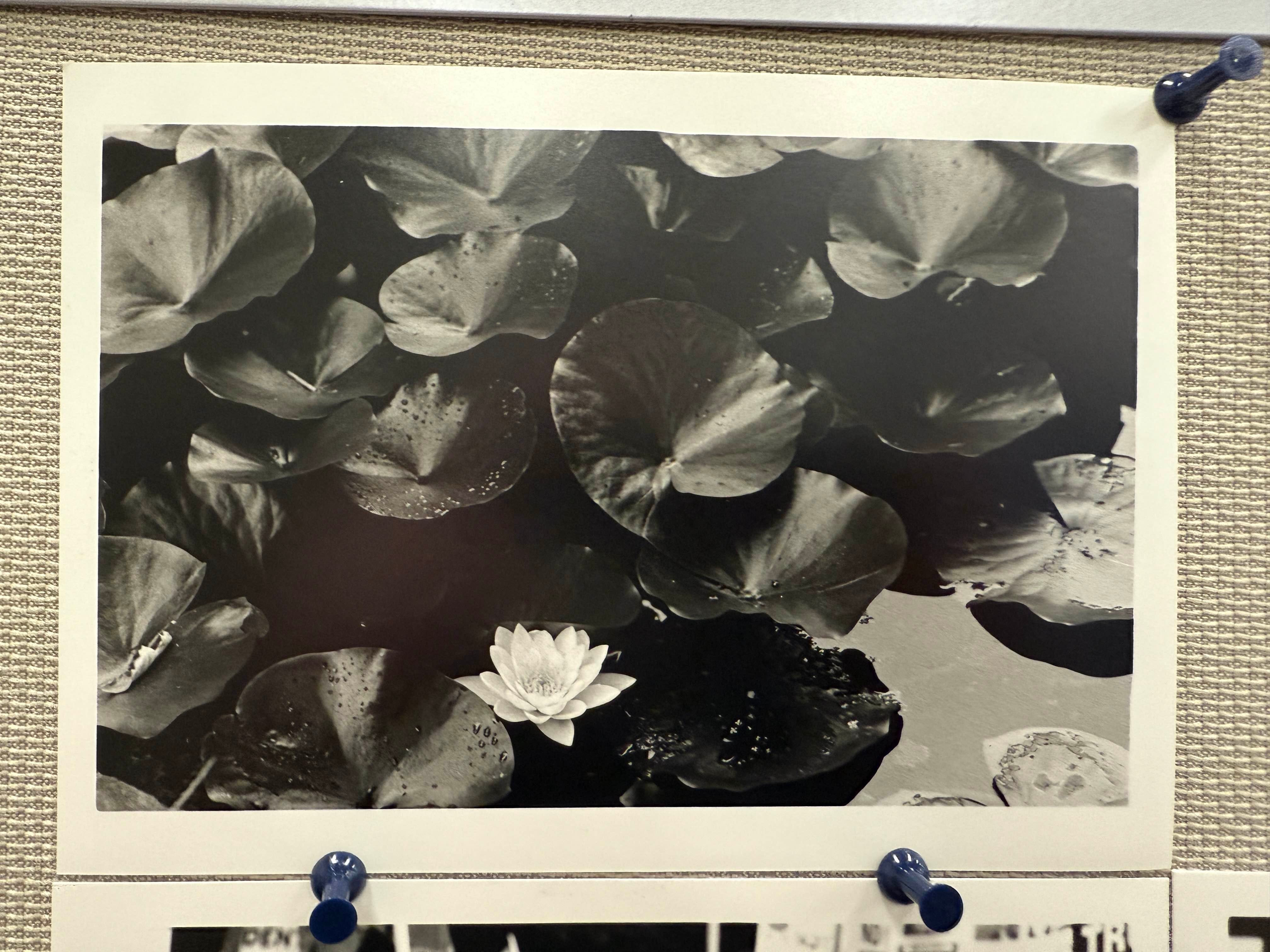
Most of the printing sessions have been of 4-5 negatives, and then only a few prints. I’d like to do more, but the enlarging paper is expensive. I don’t know what to do with the prints, once they’re done. Two of them, made for purpose, I gave to a friend moving across the country. It felt arrogant, giving something I made like that as a gift. When they sent me a picture of one hanging on their wall in their new apartment, I felt very good (proud?). The rest are, for now, just mine. I 3D-printed some frames for them, bought some acrylic sheets. I’ve got 4 or 5 framed, now hung in my living room. It feels odd to hang up my photos as decor in my apartment. But I like them. After all, I took them.
Once all the prints for the session are hung to dry, I stand there and stare at them for a bit. There is something magical about it, even though it is just chemistry and time. Everything is just chemistry and time.
Sometimes, if one looks really nice, I’ll feel almost giddy, feeling that maybe it really is something good. By far my favorite is one of a protester:


My eyes are stinging, I’m finally tired. I start to tear things down. First is the enlarging paper and the easels, back to their drawers. The timer is unplugged and put on the tray. I take out the contrast filter and store that in its little box. I carry the enlarger back to the workbench in the kitchen/office/shop. The developer and stopbath go down the drain, the fixer through a funnel back into the accordion bottle. The trays and beakers I wash and set to dry. The MDF board comes down, and the toiletry tray is placed back. It is as if nothing happened. The only evidence are the papers drying on the rod.
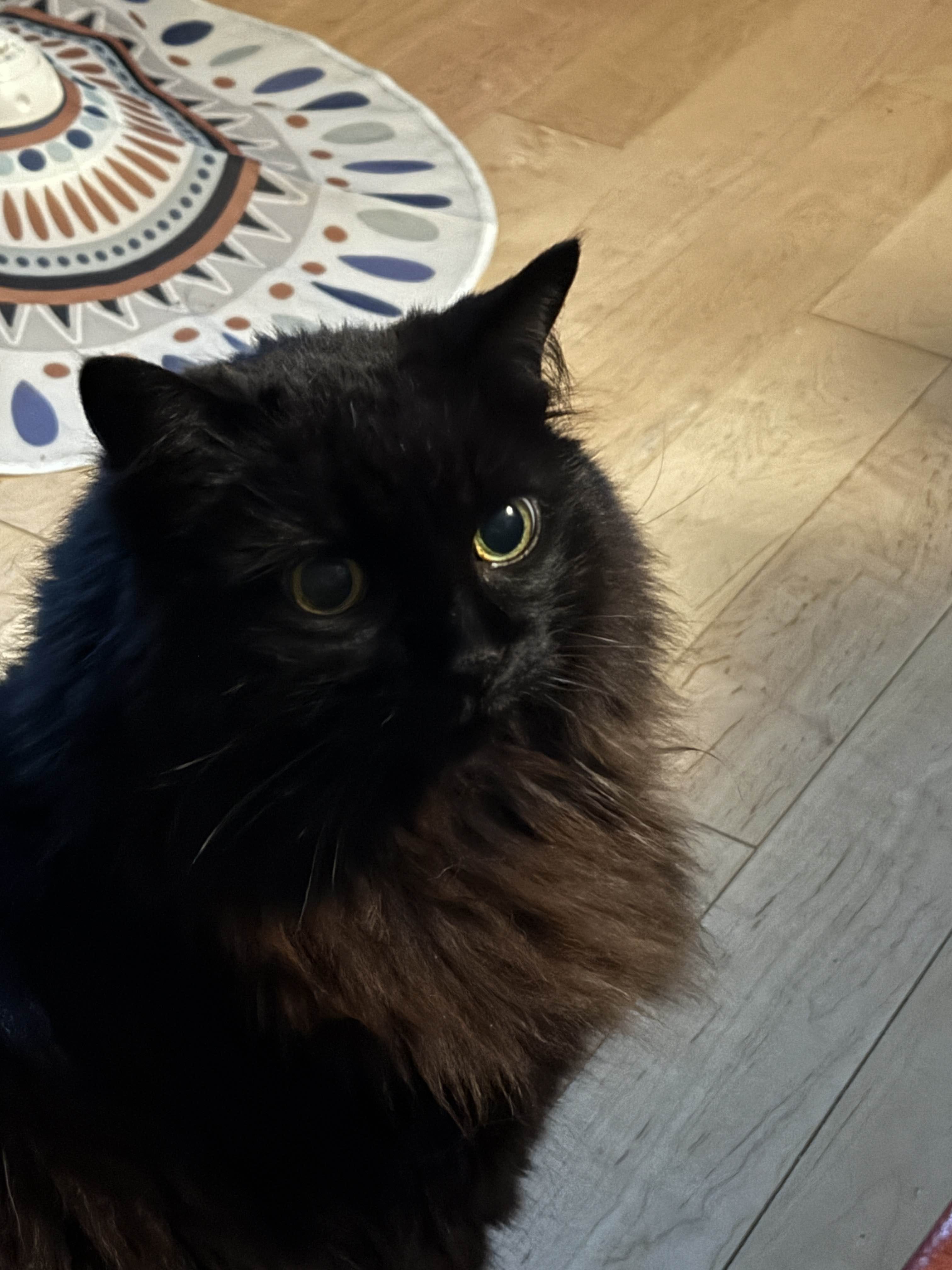
The whole thing has taken between 2 and 3 hours. It’s been meditative, and I’m still in that other place, standing there taking a last look at the drying prints. I feel a little too engaged to go right to bed. I sit on the couch and come back into the world, over 10 or 20 minutes. Eventually, my cat wanders out from the bedroom and sits, a little triangle, staring as if she’s asking why I’m not in bed yet. Partly, it is a worry that, despite the few hours of distraction, it will all come back once I’m in the dark, and I have to be with myself unfocused again. I try to stay up and distracted until I can’t keep my eyes open.
On waking, I go straight to them, as if some interloper may have stolen or destroyed them in the night. Splashed them with watermarks. They are still there, intact and dry, and it is pleasing to have made something that stays. I take them down, looking at them from all angles, then slide them into a folder and then into my bag. When I get to work, I tack them up on my cubicle wall. I’ll turn to stare at them sometimes through the day, once terribly pleased, then feeling they are generic and awful.
But, generally, I have an odd feeling of warmth, that something I’ve made is not too bad. Not too bad at all.
Thomas
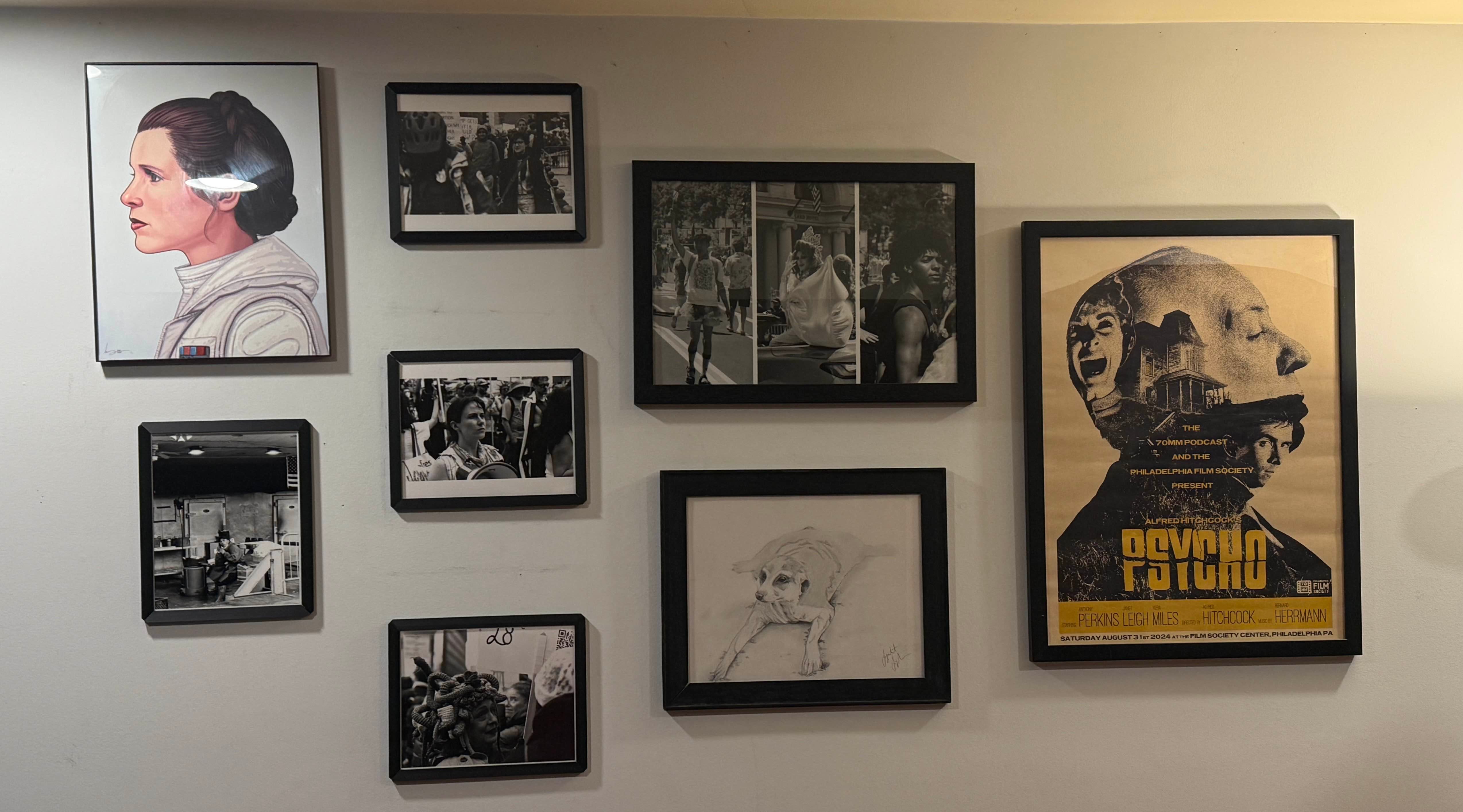
The art on the wall, in columns, left to right:
Column 1:
“Pricess Leia” by Mike Mitchell
A photo I took at the Wharf fish market.
Column 2
Protester in January 2025
Protester in June 2025
Protester in January 2025
Column 3
Triptych, WorldPride 2025
A Meerkat sketch, drawn for me as a gift from a friend in high school
Column 4
“Psycho” poster by Danny Haas